Artificial Intelligence is rapidly transforming the financial industry in the United States. From budgeting apps and AI-powered investment platforms to automated accounting software and intelligent tax optimization systems, financial AI tools are helping individuals and businesses make smarter decisions faster than ever before.
Whether you are a beginner managing your first budget, an investor looking for AI-driven stock analysis, a freelancer tracking expenses, or a business owner automating accounting operations, modern financial AI tools can significantly improve productivity, financial planning, and decision-making.
In this comprehensive guide, we will explore the best financial AI tools in the USA, compare their features, discuss real-world use cases, explain industry trends, and show how AI is shaping the future of finance.
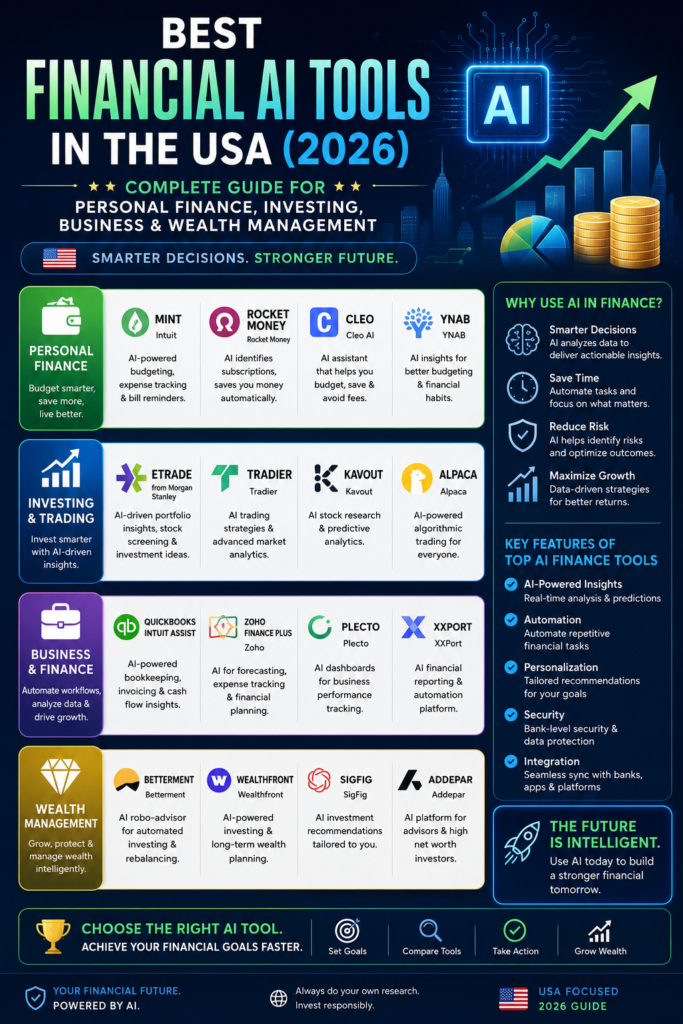
What Are Financial AI Tools?
Financial AI tools are software platforms that use artificial intelligence, machine learning, predictive analytics, natural language processing, and automation to assist with financial tasks.
These tools can help users:
- Track expenses automatically
- Analyze investments
- Predict market trends
- Automate bookkeeping
- Generate financial reports
- Optimize taxes
- Detect fraud
- Improve budgeting
- Manage business cash flow
- Offer personalized financial advice
Modern AI finance platforms are designed for both consumers and businesses, making financial management more accessible and data-driven.
Why Financial AI Tools Are Growing So Fast in the USA
The USA financial technology market is experiencing explosive growth due to several factors:
| Growth Driver | Impact |
|---|---|
| AI adoption in fintech | Faster automation and smarter predictions |
| Rising demand for passive investing | Increased use of robo-advisors |
| Small business digitalization | More cloud accounting adoption |
| Personalized finance demand | AI-based recommendations becoming popular |
| Real-time analytics | Faster financial decision-making |
| Remote work economy | Increased need for digital finance tools |
According to multiple fintech industry reports, AI-powered financial services are expected to grow dramatically over the next decade as automation becomes central to banking, investing, and business operations.
Best Financial AI Tools in the USA
1. Intuit Credit Karma
Best For:
Personal finance management and credit monitoring
Key Features
- AI-powered financial recommendations
- Credit score tracking
- Loan comparison tools
- Spending insights
- Personalized offers
- Identity monitoring
Pros
- Beginner-friendly
- Free credit tracking
- Useful financial alerts
- Strong mobile experience
Cons
- Financial product upselling
- Limited advanced investing tools
Why It Stands Out
Credit Karma uses AI to analyze user financial behavior and provide customized recommendations for loans, credit cards, and savings opportunities.
2. Rocket Money
Best For:
Budgeting and subscription management
AI Features
- Smart spending categorization
- Subscription detection
- Bill negotiation assistance
- Budget forecasting
Real-World Use Case
Many Americans unknowingly pay for unused subscriptions. Rocket Money helps identify recurring charges automatically and can even assist in canceling them.
Best For
- Families
- Young professionals
- Freelancers
- Budget-conscious users
3. Betterment
Best For:
AI-powered investing and robo-advisory
Features
- Automated portfolio management
- Tax-loss harvesting
- Goal-based investing
- Retirement planning
- AI-driven asset allocation
Why Investors Like It
Betterment simplifies investing using intelligent portfolio automation. The platform is especially popular among beginner and intermediate investors who want passive investing solutions.
4. Wealthfront
Best For:
Automated wealth management
AI Capabilities
- Smart portfolio rebalancing
- Automated tax optimization
- Cash management
- Financial planning automation
Ideal Users
- Long-term investors
- Tech-savvy millennials
- Passive income builders
Competitive Advantage
Wealthfront offers sophisticated automation that was previously accessible mainly to high-net-worth individuals.
5. QuickBooks Online
Best For:
Small business accounting
AI Features
- Automated bookkeeping
- Smart invoice categorization
- Cash flow forecasting
- AI-powered reporting
- Expense tracking automation
Why Businesses Use It
QuickBooks reduces manual accounting work significantly and helps businesses make faster financial decisions using real-time analytics.
Best For
- Startups
- Small businesses
- Ecommerce sellers
- Freelancers
6. Xero
Best For:
Cloud accounting and financial collaboration
Features
- AI bank reconciliation
- Automated expense matching
- Real-time reporting
- Payroll integration
- Business analytics
Benefits
Xero is known for its clean interface and strong integrations with ecommerce and payment platforms.
7. Kensho Technologies
Best For:
Enterprise financial analytics
AI Strengths
- Predictive financial modeling
- Market intelligence
- NLP-powered financial research
- Institutional-grade analytics
Used By
- Financial institutions
- Hedge funds
- Enterprise analysts
8. AlphaSense
Best For:
AI financial research
Key Features
- AI-powered market intelligence
- Earnings transcript analysis
- SEC filing insights
- Investment research acceleration
Why It Matters
AlphaSense helps analysts and investors discover insights faster using AI-driven search and semantic analysis.
9. Plaid
Best For:
Financial data connectivity
Features
- Secure banking APIs
- AI-driven transaction analysis
- Fraud detection support
- Financial app integrations
Industry Impact
Plaid powers many fintech apps across the United States by enabling secure financial data sharing.
10. FreshBooks
Best For:
Freelancers and service businesses
AI Capabilities
- Smart invoicing
- Automated payment reminders
- Expense categorization
- Financial reporting
Ideal For
- Consultants
- Agencies
- Remote workers
- Independent professionals
Comparison Table: Best Financial AI Tools in the USA
| Tool | Best For | AI Features | Pricing Type |
|---|---|---|---|
| Credit Karma | Personal finance | AI recommendations | Free |
| Rocket Money | Budgeting | Subscription AI detection | Freemium |
| Betterment | Investing | Robo-advisor AI | Paid |
| Wealthfront | Wealth management | Portfolio automation | Paid |
| QuickBooks | Accounting | AI bookkeeping | Subscription |
| Xero | Cloud finance | AI reconciliation | Subscription |
| Kensho | Enterprise analytics | Predictive AI | Enterprise |
| AlphaSense | Research | AI market intelligence | Enterprise |
| Plaid | Financial APIs | Data intelligence | API pricing |
| FreshBooks | Freelancers | Smart automation | Subscription |
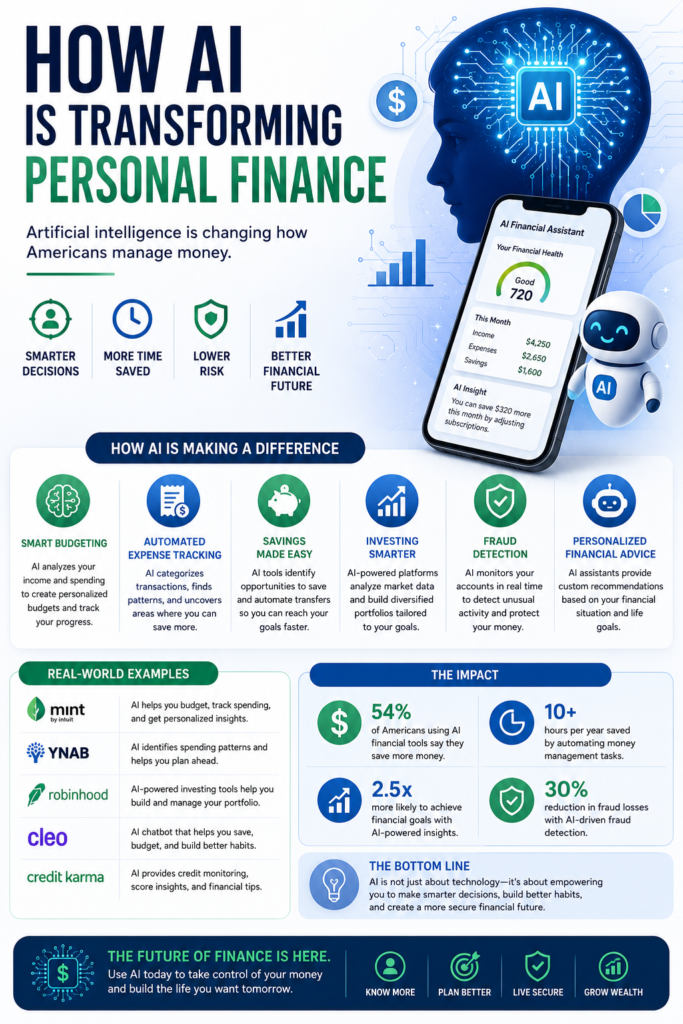
How AI Is Transforming Personal Finance
Artificial intelligence is changing how Americans manage money.
Major AI Trends in Personal Finance
1. Hyper-Personalized Recommendations
AI tools now analyze spending habits and provide customized financial suggestions based on user behavior.
2. Automated Savings
Many AI finance apps automatically move money into savings based on spending patterns and income flow.
3. Smart Credit Monitoring
AI systems can detect unusual activity and help users improve credit scores strategically.
4. Financial Chatbots
Conversational AI assistants are making financial advice more accessible and interactive.
AI Investing Tools and Robo-Advisors
AI-powered investing platforms are becoming increasingly popular because they simplify wealth management.
Key Advantages
- Lower fees
- Automated diversification
- Reduced emotional investing
- Tax optimization
- 24/7 portfolio monitoring
Common AI Investing Features
| Feature | Benefit |
|---|---|
| Portfolio Rebalancing | Maintains target allocations |
| Risk Analysis | Personalized investing strategies |
| Tax-Loss Harvesting | Potential tax savings |
| Predictive Analytics | Smarter investment insights |
| Automated Deposits | Consistent investing habits |
Best AI Accounting Tools for Businesses
Businesses across the USA are adopting AI accounting software to reduce manual work and improve accuracy.
Benefits of AI Accounting
- Faster bookkeeping
- Reduced human error
- Automated invoicing
- Better cash flow visibility
- Smart forecasting
- Improved compliance
Industries Using AI Finance Tools
- Ecommerce
- SaaS businesses
- Agencies
- Retail stores
- Real estate companies
- Healthcare providers
- Consultants
Step-by-Step Guide: Choosing the Right Financial AI Tool
Step 1: Identify Your Financial Goal
Choose based on your primary need:
- Budgeting
- Investing
- Accounting
- Tax optimization
- Research
- Wealth management
Step 2: Determine Your Budget
Some tools are free, while enterprise-grade platforms can cost thousands annually.
Step 3: Check Integrations
Ensure compatibility with:
- Banks
- Credit cards
- Accounting systems
- Ecommerce platforms
- Payroll systems
Step 4: Evaluate Security
Look for:
- Bank-level encryption
- Multi-factor authentication
- Secure APIs
- Regulatory compliance
Step 5: Compare Automation Features
More automation can save significant time and reduce operational complexity.
Industry Insights: The Future of Financial AI in the USA
The future of AI in finance looks extremely promising.
Major Industry Trends
AI-Powered Wealth Advisors
AI-driven advisory platforms are becoming mainstream for retail investors.
Predictive Finance
Future AI systems may forecast financial risks and opportunities with greater accuracy.
Voice-Based Financial Assistants
Voice-enabled AI finance assistants are expected to grow rapidly.
AI Fraud Detection
Financial institutions are heavily investing in AI security and fraud prevention systems.
AI + Blockchain Integration
Emerging fintech platforms are combining AI with blockchain technology for enhanced transparency and automation.
Real-World Examples of Financial AI Adoption
Example 1: Small Business Automation
A small ecommerce business can automate:
- Bookkeeping
- Expense tracking
- Invoicing
- Tax preparation
using AI accounting software.
Example 2: Passive Investing
An investor using robo-advisors can automate:
- Monthly investing
- Asset allocation
- Portfolio balancing
- Retirement planning
with minimal manual effort.
Example 3: Personal Budgeting
Consumers can use AI apps to:
- Detect overspending
- Reduce subscriptions
- Improve savings
- Monitor credit health
Beginner Mistakes to Avoid
1. Choosing Tools Without Clear Goals
Always define your financial objectives first.
2. Ignoring Security
Financial tools handle sensitive data. Security should be a top priority.
3. Over-Automating Everything
AI helps decision-making but should not completely replace human judgment.
4. Ignoring Fees
Subscription costs and management fees can impact long-term returns.
5. Following AI Blindly
AI predictions are not always accurate. Users should verify important financial decisions.
Are Financial AI Tools Safe?
Most leading financial AI platforms use advanced security measures such as:
- Encryption
- Secure APIs
- Fraud detection
- Authentication systems
- Compliance protocols
However, users should:
- Use strong passwords
- Enable multi-factor authentication
- Avoid suspicious apps
- Review privacy policies carefully
How Financial AI Tools Support Businesses
AI-powered finance tools can improve:
| Business Area | AI Benefit |
|---|---|
| Accounting | Automation |
| Forecasting | Predictive insights |
| Payroll | Error reduction |
| Tax planning | Compliance assistance |
| Reporting | Faster analytics |
| Customer payments | Better cash flow |
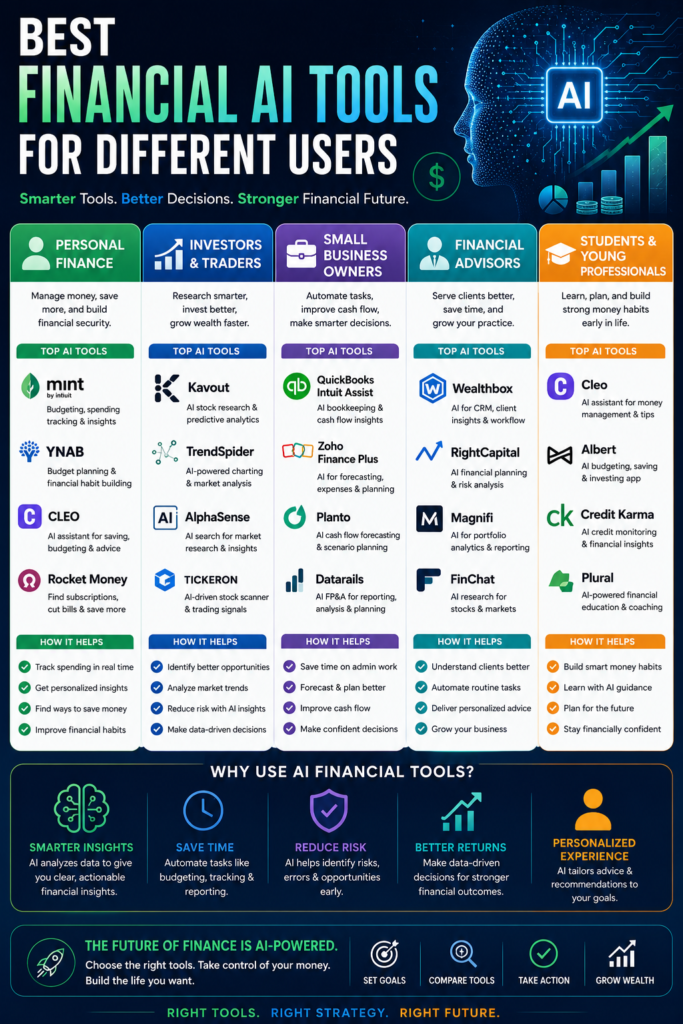
Best Financial AI Tools for Different Users
| User Type | Recommended Tool |
|---|---|
| Beginners | Credit Karma |
| Investors | Betterment |
| Wealth Builders | Wealthfront |
| Freelancers | FreshBooks |
| Small Businesses | QuickBooks |
| Enterprises | Kensho |
| Researchers | AlphaSense |
| Budget-Conscious Users | Rocket Money |
Financial AI vs Traditional Financial Management
| Traditional Finance | AI Finance |
|---|---|
| Manual tracking | Automated insights |
| Slower analysis | Real-time analytics |
| Human-only decisions | AI-assisted decisions |
| Higher labor costs | Greater automation |
| Limited scalability | Highly scalable systems |
The Role of AI in Modern Banking
Banks in the USA increasingly use AI for:
- Fraud detection
- Customer service
- Loan approvals
- Risk analysis
- Transaction monitoring
- Personalized banking recommendations
AI banking technology is expected to become even more advanced in the coming years.
Frequently Asked Questions (FAQ)
What is the best AI finance tool for beginners?
For beginners, tools like Credit Karma and Rocket Money are excellent because they simplify budgeting, spending analysis, and credit monitoring with user-friendly interfaces.
Are AI investing tools better than human advisors?
AI investing tools can reduce costs and automate portfolio management efficiently. However, complex financial planning may still benefit from human expertise.
Can AI tools help businesses save money?
Yes. AI finance tools reduce manual work, improve accuracy, automate repetitive tasks, and help businesses optimize operations.
Are financial AI tools secure?
Most reputable platforms use bank-level encryption and strong security systems. Users should still practice good cybersecurity habits.
Which AI accounting software is best for small businesses?
QuickBooks and Xero are among the most popular AI-powered accounting platforms for small businesses in the USA.
Can AI predict stock market movements accurately?
AI can analyze trends and historical data, but no system can predict the market with complete accuracy.
Do financial AI tools replace accountants or advisors?
AI tools assist professionals rather than fully replacing them. Human oversight remains important for strategic decisions.
Key Takeaways
- Financial AI tools are transforming money management in the USA.
- AI platforms improve automation, insights, and financial efficiency.
- Personal finance, investing, accounting, and research tools are rapidly evolving.
- Businesses and individuals can both benefit from AI-powered financial systems.
- Security, usability, and automation are critical factors when choosing a platform.
- AI finance adoption is expected to grow significantly in the coming years.
Conclusion
Artificial intelligence is redefining the future of finance in the United States. From personal budgeting apps and robo-advisors to enterprise analytics platforms and AI-powered accounting systems, financial AI tools are helping users make smarter decisions with greater efficiency.
The best financial AI tool ultimately depends on your goals, experience level, budget, and financial needs. Beginners may prefer budgeting and credit monitoring apps, while investors and businesses often benefit from more advanced automation and analytics platforms.
As AI technology continues to evolve, financial management will likely become increasingly personalized, automated, and data-driven. Individuals and businesses that adopt intelligent financial systems early may gain significant long-term advantages.
Disclaimer: This article is for educational purposes only. Results and financial outcomes vary based on experience, effort, market conditions, and individual circumstances. This is not financial, legal, or investment advice.
Affiliate Disclosure: Some links, tools, or services mentioned in this article may be affiliate links. The website may earn a commission at no extra cost to you.
SEO + GEO Optimization Output
SEO Title
Best Financial AI Tools in the USA (2026 Guide)
GEO-Friendly Meta Description
Discover the best financial AI tools in the USA for personal finance, investing, accounting, budgeting, and business automation. Compare top AI finance platforms, robo-advisors, and smart accounting tools in this complete 2026 guide.
Suggested URL Slug
best-financial-ai-tools-usa
Focus Keyword
Best Financial AI Tools USA
Related Keywords
- AI finance tools
- AI investing apps
- robo advisors USA
- AI accounting software
- AI budgeting apps
- personal finance AI
- business finance AI
- fintech AI tools
- automated investing platforms
- AI wealth management
- smart accounting software
- financial automation tools
- AI stock analysis tools
- AI fintech platforms
- AI money management apps
Semantic Keywords
- artificial intelligence in finance
- machine learning finance platforms
- AI-powered investing
- intelligent financial planning
- predictive financial analytics
- automated budgeting systems
- financial technology trends
- digital wealth management
Entity Keywords
- Intuit
- Credit Karma
- Betterment
- Wealthfront
- QuickBooks
- Xero
- Plaid
- AlphaSense
- Kensho
- Rocket Money
Suggested Internal Linking Ideas
- Best AI Tools for Small Businesses
- How to Start Investing with AI
- Best Budgeting Apps in the USA
- AI Tools for Freelancers
- Passive Income Strategies
- Fintech Trends in 2026
Suggested External Linking Ideas
- Federal Reserve
- SEC investment resources
- FINRA investor education
- Official fintech company blogs
- Financial literacy organizations
Image Alt Text Suggestions
- AI finance dashboard
- best robo advisor platforms
- AI accounting software interface
- financial AI tools comparison chart
- fintech AI automation concept
- smart budgeting app example
Social Media Caption
Discover the best financial AI tools in the USA for budgeting, investing, accounting, and business automation. Compare top AI finance platforms and learn how artificial intelligence is transforming money management in 2026.
Suggested Schema Markup Types
- Article Schema
- FAQ Schema
- Breadcrumb Schema
- Product Schema
- Review Schema
FAQ Schema Suggestions
Include structured FAQ markup for:
- Best AI finance tools
- AI investing safety
- AI accounting software
- robo-advisors
- AI budgeting tools
Article Schema Suggestions
Use:
- Headline
- Author
- DatePublished
- DateModified
- Publisher
- MainEntityOfPage
- Image
- Description
Breadcrumb Schema Suggestions
Home > AI Tools > Finance AI Tools > Best Financial AI Tools USA
Leave a Reply