Investing in dividend stocks is one of the most beginner-friendly ways to build long-term wealth and create passive income. Dividend-paying companies reward shareholders by distributing a portion of their profits regularly, usually every quarter.
For beginners, dividend investing offers two major advantages:
- Potential regular income
- Long-term portfolio growth
In this guide, you’ll learn what dividend stocks are, how they work, the best dividend stocks for beginners, how to choose them, common mistakes to avoid, and practical strategies for building a strong dividend portfolio in 2026.
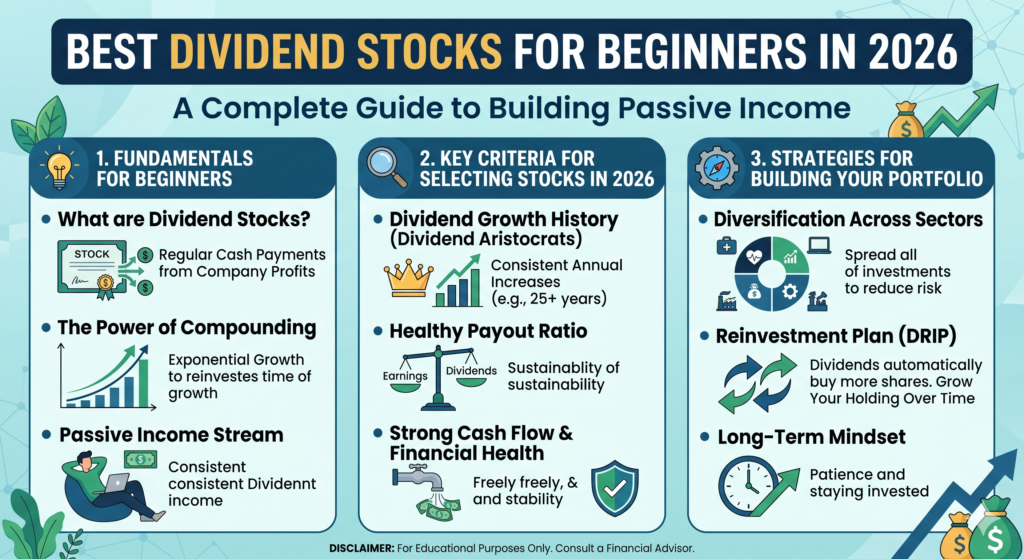
What Are Dividend Stocks?
Dividend stocks are shares of companies that regularly pay part of their earnings to shareholders.
These payments are called dividends.
Most dividend-paying companies are large, financially stable businesses with consistent profits. Popular sectors include:
- Banking
- Consumer goods
- Energy
- Healthcare
- Utilities
- Telecom
- Technology
For example:
If a company pays a dividend of $2 annually and you own 100 shares, you may receive $200 per year in dividend income.
Why Dividend Stocks Are Good for Beginners
Dividend investing is often considered safer and more stable than chasing high-growth speculative stocks.
Key Benefits of Dividend Stocks
| Benefit | Explanation |
|---|---|
| Passive Income | Earn regular payouts without selling stocks |
| Lower Volatility | Dividend companies are often stable businesses |
| Compounding Growth | Reinvested dividends can grow wealth faster |
| Long-Term Wealth | Many dividend stocks appreciate over time |
| Inflation Protection | Some companies increase dividends yearly |
| Beginner-Friendly | Easier to understand compared to complex trading strategies |
How Dividend Stocks Work
When a company earns profits, it may:
- Reinvest profits into growth
- Buy back shares
- Pay dividends to investors
Dividends are usually paid:
- Quarterly
- Semi-annually
- Annually
The dividend amount depends on:
- Company profits
- Financial health
- Dividend policy
- Economic conditions

Business
Lorem ipsum dolor sit amet, consectetur adipiscing.

Storefront
Lorem ipsum dolor sit amet, consectetur adipiscing.

Blogging
Lorem ipsum dolor sit amet, consectetur adipiscing.

Portfolio
Lorem ipsum dolor sit amet, consectetur adipiscing.
Slow Thoughts, Simple Living
Aenean egestas augue porta erat finibus malesuada. Nulla facilisi. Integer vel rutrum mi, sit amet faucibus nisi. Suspendisse fringilla diam eget est vestibulum pharetra.
Important Dividend Terms Beginners Should Know
Dividend Yield
Dividend yield shows how much income a stock generates relative to its price.
Formula:
Dividend Yield=Stock PriceAnnual Dividend×100
Example:
If a stock pays $4 annually and costs $100:
Dividend Yield = 4%
Dividend Payout Ratio
This shows how much profit the company pays as dividends.
Lower payout ratios are usually safer.
Dividend Aristocrats
These are companies that have increased dividends for 25+ consecutive years.
They are often considered reliable long-term investments.
Dividend Reinvestment
Instead of taking cash payouts, investors can automatically reinvest dividends into buying more shares.
This helps compound returns over time.
Best Dividend Stocks For Beginners in 2026
Below are some popular dividend stocks beginners often consider for long-term investing.
Note: Dividend yields and stock performance change regularly. Always do your own research before investing.
1. Johnson & Johnson
Why Beginners Like It
- Stable healthcare business
- Long dividend history
- Defensive stock during market downturns
Key Advantages
- Consistent cash flow
- Global brand recognition
- Strong financial stability
Best For
Long-term conservative investors.
2. Coca-Cola
Why It’s Popular
- Iconic global brand
- Reliable dividend payments
- Strong international market presence
Beginner Benefit
Easy-to-understand business model.
3. Procter & Gamble
What Makes It Attractive
- Owns trusted household brands
- Strong recession-resistant business
- Decades of dividend growth
Products Include
- Personal care
- Cleaning products
- Health products
4. PepsiCo
Why Investors Like It
- Diversified food and beverage portfolio
- Strong global distribution
- Consistent dividends
5. Microsoft
Why It’s a Strong Choice
- Technology leader
- Strong cash reserves
- Growing dividend payments
Beginner Advantage
Combines growth potential with dividend income.
6. McDonald’s
Why It’s Beginner-Friendly
- Global business model
- Strong brand loyalty
- Long-term dividend growth
7. Apple
Why Many Investors Consider It
- Massive profitability
- Strong ecosystem
- Consistent dividend increases
Although yield may be smaller than traditional dividend stocks, growth potential is significant.
Dividend Stocks vs Growth Stocks
| Feature | Dividend Stocks | Growth Stocks |
|---|---|---|
| Income | Regular dividends | Usually no dividends |
| Stability | Generally stable | More volatile |
| Risk Level | Moderate | Higher |
| Best For | Long-term income | Aggressive growth |
| Suitable for Beginners | Yes | Sometimes |
How Beginners Can Choose Good Dividend Stocks
Not all high-dividend stocks are good investments.
Here are important factors beginners should analyze.
1. Check Dividend History
Look for companies that:
- Pay dividends consistently
- Increase payouts regularly
- Survive economic downturns
2. Analyze Dividend Yield Carefully
Very high yields can sometimes indicate financial problems.
Many stable dividend investors prefer:
- Moderate
- Sustainable
- Consistent yields
3. Review Financial Health
Important metrics include:
- Revenue growth
- Profit margins
- Debt levels
- Cash flow
Strong companies usually maintain dividends more reliably.
4. Understand the Business
Invest in companies you understand.
Examples:
- Consumer brands
- Healthcare
- Utilities
- Technology giants
5. Diversify Your Portfolio
Avoid putting all money into one stock or sector.
A diversified portfolio may reduce risk.
Beginner Dividend Portfolio Example
| Sector | Example Stock Type |
|---|---|
| Healthcare | Stable dividend company |
| Consumer Goods | Household brands |
| Technology | Dividend growth stock |
| Utilities | Defensive dividend stock |
| Banking | Income-focused stock |
How Much Money Do You Need to Start?
One major benefit of dividend investing is accessibility.
You can start with:
- $10
- $50
- $100
- Or monthly SIP-style investing
Many brokers now offer:
- Fractional shares
- Commission-free investing
- Automatic dividend reinvestment
Best Strategies for Beginner Dividend Investors
1. Buy and Hold Strategy
Long-term investing often works better than frequent trading.
2. Reinvest Dividends
Dividend reinvestment can significantly increase long-term returns through compounding.
3. Focus on Quality Over Yield
A safe 3% yield is often better than a risky 12% yield.
4. Invest Consistently
Monthly investing can help reduce market timing risk.
5. Stay Patient
Dividend investing is usually a long-term wealth-building strategy.
Common Mistakes Beginners Should Avoid
| Mistake | Why It’s Risky |
|---|---|
| Chasing extremely high yields | May signal financial trouble |
| Ignoring diversification | Increases portfolio risk |
| Panic selling | Hurts long-term returns |
| Investing without research | Can lead to poor decisions |
| Focusing only on dividends | Total business quality matters too |
Dividend ETFs for Beginners
Some beginners prefer dividend ETFs instead of individual stocks.
Dividend ETFs provide:
- Diversification
- Lower risk
- Easier management
Popular examples include:
- Dividend growth ETFs
- High-yield ETFs
- Broad market dividend funds
Are Dividend Stocks Safe?
No investment is completely risk-free.
Dividend stocks can still:
- Decline in price
- Cut dividends
- Face economic challenges
However, established dividend companies are often considered less volatile compared to speculative growth stocks.
How Dividend Investing Builds Wealth Over Time
Long-term dividend investing benefits from compounding.
Example:
- Initial investment: $5,000
- Regular monthly investing
- Dividend reinvestment
- Long-term growth
Over decades, compounding can potentially accelerate portfolio growth significantly.
Best Sectors for Beginner Dividend Investors
Consumer Staples
Examples:
- Food
- Beverages
- Household products
Often stable during recessions.
Healthcare
Healthcare companies may benefit from long-term demand growth.
Utilities
Utilities are known for:
- Stable income
- Defensive characteristics
- Reliable dividends
Technology
Some mature technology companies now pay growing dividends.
Dividend Stocks and Retirement Income
Many investors use dividend stocks to:
- Supplement retirement income
- Build passive cash flow
- Reduce reliance on salary income
This is one reason dividend investing remains popular globally.
Quick Checklist Before Buying Dividend Stocks
Ask These Questions
- Does the company have stable earnings?
- Is the dividend sustainable?
- Does the company have manageable debt?
- Is the business easy to understand?
- Has management increased dividends historically?
Quick Takeaways
- Dividend stocks can help beginners build passive income
- Focus on financially strong companies
- Avoid chasing unrealistic high yields
- Diversification helps reduce risk
- Long-term investing is usually more effective
- Reinvesting dividends may accelerate compounding
Final Thoughts
Dividend investing remains one of the most practical and beginner-friendly investing strategies in 2026.
Instead of chasing fast profits, many successful long-term investors focus on:
- Stability
- Consistency
- Compounding
- Quality businesses
For beginners, starting small and investing consistently may be more important than trying to predict short-term market movements.
A disciplined dividend strategy combined with patience can help create long-term financial growth over time.
FAQ Section
What are dividend stocks?
Dividend stocks are shares of companies that regularly distribute a portion of profits to shareholders. These payments are called dividends and are usually paid quarterly.
Are dividend stocks good for beginners?
Yes, dividend stocks are often considered beginner-friendly because they can provide regular income, lower volatility, and long-term growth potential compared to speculative stocks.
How do beginners start investing in dividend stocks?
Beginners can open a brokerage account, research stable dividend-paying companies, start with small investments, diversify holdings, and reinvest dividends for compounding growth.
What is a good dividend yield for beginners?
Many investors consider moderate and sustainable yields safer than extremely high yields. The ideal yield depends on company quality, financial stability, and long-term growth potential.
Can dividend stocks make passive income?
Yes, dividend stocks can generate passive income through regular dividend payments. However, income levels depend on investment size, company performance, and market conditions.
Are dividend ETFs better than individual stocks?
Dividend ETFs may be easier for beginners because they offer diversification and lower company-specific risk. Individual stocks may provide more control but require more research.
Do dividend stocks always go up?
No. Dividend stocks can fluctuate in price like all investments. Companies can also reduce or suspend dividends during financial difficulties.
Should beginners reinvest dividends?
Many long-term investors reinvest dividends because it can help compound returns and increase portfolio growth over time.
Disclaimer
Disclaimer: This article is for educational purposes only. Results and financial outcomes vary based on experience, effort, market conditions, and individual circumstances. This is not financial or legal advice.
Affiliate Disclosure
Affiliate Disclosure: Some links or tools mentioned in this article may be affiliate links. The website may earn a commission at no extra cost to you.
Leave a Reply