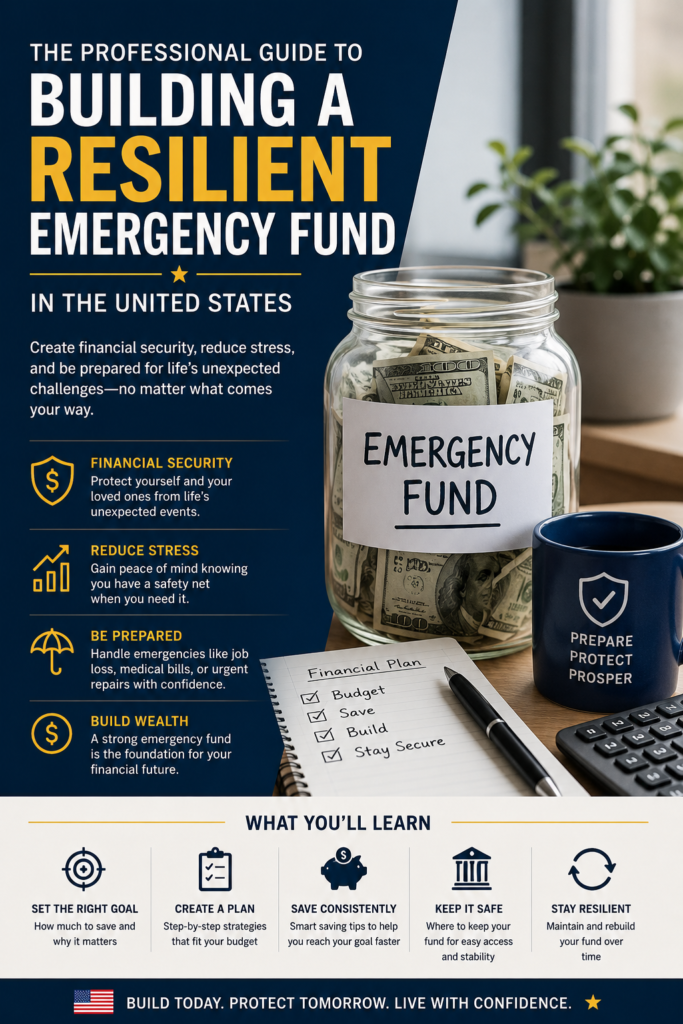
- What is an emergency fund? A dedicated, liquid cash reserve reserved exclusively for unplanned, essential expenses or catastrophic income disruptions.
- How much do you need? For working professionals with stable W-2 income, 3 to 6 months of essential living expenses is standard. For freelancers, small business owners, or high-variable-income households, 6 to 12 months is strongly recommended to buffer against market volatility.
- Where should it be kept? In a secure, highly liquid, yield-bearing instrument, primarily a High-Yield Savings Account (HYSA) or a Money Market Account (MMA) protected by FDIC or NCUA insurance.
Key Takeaways
- Risk Isolation: An emergency fund represents capital preservation and risk isolation, not wealth accumulation. Do not expose these funds to equity markets or illiquid instruments.
- Dynamic Calculations: Base your savings target on essential baseline survival expenses (housing, debt servicing, healthcare, core nutrition) rather than gross current expenditures.
- Inflation Protection: Capitalizing on current interest rate environments using modern fintech accounts allows savers to hedge principal cash reserves against inflationary erosion without introducing asset volatility.
Introduction
In the contemporary macroeconomic landscape, financial resilience is the baseline requirement for personal and professional stability. For American working professionals, real estate investors, and enterprise founders, an unexpected disruption—be it corporate down-sizing, systemic banking adjustments, medical events, or supply chain bottlenecks—can compromise capital structures if not properly hedged.
An emergency fund serves as a core self-insurance mechanism. It acts as a non-correlated capital cushion designed to isolate personal living standards from unexpected financial shocks, ensuring you never have to liquidate long-term investment portfolios or rely on high-interest debt instruments during a crisis. This comprehensive architectural manual outlines the exact mechanisms required to calculate, optimize, and maintain a high-performance cash reserve within the United States financial ecosystem.
Definition & Systemic Infrastructure
To build an efficient cash reserve, one must distinguish between true financial emergencies and variable lifestyle costs.
                  +-----------------------------------+
                  |      LIQUID CAPITAL RESERVE       |
                  +-----------------------------------+
                                    |
          +-------------------------+-------------------------+
          |                                                   |
          v                                                   v
+-----------------------------------+               +-----------------------------------+
|       True Emergency Fund         |               |       Sinking/Variable Funds      |
|  (Unplanned, Non-Discretionary)   |               |    (Anticipated, Discretionary)   |
+-----------------------------------+               +-----------------------------------+
| * Systemic Job Loss / Layoffs     |               | * Q4 Property Tax Payments        |
| * Non-Elective Medical Procedures |               | * Corporate Travel Expense        |
| * Structural Home Failures        |               | * Scheduled Vehicle Fleet Maint.  |
+-----------------------------------+               +-----------------------------------+
True Emergency Fund
A structured capital allocation designated exclusively for unplanned, non-discretionary expenses. This capital must remain safe from market volatility and accessible within a 24-to-48-hour window.
Sinking Funds
Predictable, variable expenditures that should be actively budgeted for throughout the fiscal year. These include quarterly tax obligations, cyclical insurance premiums, routine auto maintenance, and annual software renewals. Conflating these categories can easily lead to a false sense of security and leave your true emergency reserves underfunded.
The Strategic Framework: Calculating Capital Allocation Targets
Determining your target emergency fund balance requires a detailed audit of baseline operational expenses. Gross revenue or top-line household income should not be used as your benchmark. Instead, focus entirely on Essential Outlays (Baseline Monthly Burn Rate).
The Baseline Survival Metric
Your baseline burn rate includes the absolute non-negotiable costs required to maintain structural viability over a 30-day cycle:
- Debt Servicing & Housing: Mortgage principal/interest or lease obligations, HOA fees, essential utilities (power, water, connectivity).
- Core Insurance & Healthcare: Health insurance premiums, deductibles, required maintenance prescriptions, and mandatory auto/property coverage.
- Statutory Obligations: Minimum required distributions, structured settlement costs, or legal non-discretionary payments.
- Baseline Sustenance: Essential nutrition and core local transportation costs. Discretionary culinary spending, subscriptions, and luxury items are completely removed from this calculation.
Risk Profiling Matrix
The appropriate size of your emergency fund depends on your income stability, asset structure, and professional dependencies. Use this matrix to find your recommended savings target:
| Professional Cohort | Risk Variables | Recommended Capital Cushion |
|---|---|---|
| W-2 Salaried Enterprise Employees | Single or dual steady income streams, low capital expenditure exposure. | 3 to 6 Months of Baseline Outlays |
| Freelancers & Gig-Economy Professionals | High client churn, variable accounts receivable cycles, macroeconomic sensitivity. | 6 to 9 Months of Baseline Outlays |
| Small Business Owners & Founders | Personal guarantees on commercial debt, cash flow volatility, payroll exposure. | 9 to 12 Months of Baseline Outlays |
| Real Estate Investors & General Partners | Unplanned portfolio capital calls, tenant vacancies, emergency structural repairs. | 6 to 12 Months of Portfolio Operating Costs |
Step-by-Step Execution Plan
Building a fully funded reserve requires a systematic operational framework. Follow this sequence to establish and scale your liquidity reserve without disrupting your broader wealth-building strategies.
-
Conduct a Comprehensive Capital Flow Audit: Phase 1: Analytics.
Review your last 90 days of banking statements, corporate ledgers, and credit accounts. Separate non-discretionary spending from discretionary lifestyle choices to calculate your precise monthly baseline burn rate. -
Establish an Isolated Intermediate Capital Anchor: Phase 2: Infrastructure.
Open a dedicated yield-bearing account completely separate from your primary transactional bank. This physical separation prevents impulse spending and simplifies cash tracking. -
Automate Capital Inflows via Split Paycheck Routing: Phase 3: Automation.
Configure your payroll system or ACH infrastructure to automatically route a specific percentage of top-line revenue into your reserve account on day one. Treating savings as a non-negotiable expense ensures consistent growth. -
Fund the Initial Liquid Baseline: Phase 4: Milestone 1.
Prioritize building a flat $1,000 to $2,500 intermediate buffer as fast as possible. Pause non-essential capital allocations, high-risk investments, or accelerated principal debt payments until this baseline is secured. -
Scale to Full Capacity Realignment: Phase 5: Completion.
Maintain consistent capital inflows until you hit your target tier (3, 6, or 12 months of expenses). Once reached, stop additional allocations to this reserve and redirect those cash flows into wealth-generation or investment vehicles.
Financial Vehicle Architecture: Asset Placement
Where you store your emergency fund matters just as much as how much you save. The ideal vehicle balances capital preservation, high liquidity, and competitive yields.
1. High-Yield Savings Accounts (HYSAs)
HYSAs are the premier choice for modern liquidity management. Offered primarily by digital banking institutions, these accounts avoid the heavy overhead costs of physical branch networks, allowing them to pass higher yields back to depositors.
- Yield Environment: Typically yield 10x to 20x more than traditional brick-and-mortar savings products.
- Liquidity Mechanics: Offers instant electronic transfers via ACH or real-time payment networks, generally settling within 1 to 2 business days.
- Regulatory Backing: Fully backed by the Federal Deposit Insurance Corporation (FDIC) up to $250,000 per depositor, per insured bank, across each account ownership category.
2. Money Market Accounts (MMAs)
Money Market Accounts combine the interest-bearing features of a savings account with the transactional flexibility of a checking account.
- Transactional Features: Often feature direct check-writing capabilities and debit card access, providing faster liquidity during a major emergency.
- Regulatory Backing: Insured by the FDIC (for banks) or the National Credit Union Administration (NCUA, for credit unions) up to standard statutory limits.
3. Short-Term Treasury Instruments & Capital Baskets
For advanced portfolios, a portion of your emergency fund can be tiered across short-term sovereign debt instruments like U.S. Treasury Bills (T-Bills) or ultra-low-cost Treasury Money Market Mutual Funds.
- Tax Efficiency: Interest earned on U.S. Treasury instruments is typically exempt from state and local income taxes, making this a highly efficient option for professionals in high-tax states like California or New York.
- Liquidity Considerations: Settlement times require matching market hours, meaning these funds should be used as secondary lines of liquidity rather than your primary cash bucket.
Strategic Architecture: The Tiered Reserve Liquidity Model
To maximize earnings without compromising immediate access to your money, consider deploying a Tiered Reserve System. This structure divides your emergency fund into separate tranches based on urgency and investment timelines.
+-------------------------------------------------------------------------+
|                      TOTAL EMERGENCY CAPITAL RESERVE                    |
+-------------------------------------------------------------------------+
                                     |
         +---------------------------+---------------------------+
         |                           |                           |
         v                           v                           v
+------------------+       +------------------+       +------------------+
|     TIER I       |       |     TIER II      |       |    TIER III      |
| Immediate Buffer |       |  Primary Core    |       | Extended Cushion |
+------------------+       +------------------+       +------------------+
| * 10-15% of Fund |       | * 50-60% of Fund |       | * 25-40% of Fund |
| * Checking/MMA   |       | * Premium HYSA   |       | * Treasury Bills |
| * Instant Access |       | * 24-48hr Settl. |       | * Tax-Advantaged |
+------------------+       +------------------+       +------------------+
Tier I: Immediate Liquid Operational Buffer (10% – 15% of Total Allocations)
- Objective: Immediate response to sudden, time-sensitive events (e.g., immediate medical co-pays, critical transit repairs).
- Vehicle: Primary checking account or an instantly accessible Money Market Account with debit functionality.
- Yield Target: Low to nominal. Security and speed are the priorities here.
Tier II: Primary Core Capital Cushion (50% – 60% of Total Allocations)
- Objective: Cover systemic, structural shortfalls, such as cyclical job loss, prolonged corporate client issues, or major medical events.
- Vehicle: Premium digital High-Yield Savings Account.
- Yield Target: Maximum available FDIC-insured yield. Settles via ACH transfer within 24 to 48 hours.
Tier III: Extended Strategic Reserve (25% – 40% of Total Allocations)
- Objective: Insulation against extended macroeconomic downturns or deep industry recessions.
- Vehicle: Rolling 4-week or 8-week U.S. Treasury Bill ladders, or high-grade Treasury Money Market Funds.
- Yield Target: State-and-local tax-exempt sovereign yields. Accessible upon asset maturity or market liquidation settlement.
Advanced Financial Insights & Macro Trends
The financial landscape has changed dramatically over the past few years, bringing new challenges and tools for liquidity management:
- Yield Optimization Realities: High interest rate environments make choosing the right storage vehicle critical. Leaving your cash in a traditional bank account yielding a nominal 0.01% effectively loses purchasing power to inflation every day. Moving those reserves to a high-yield account is an easy, necessary step to protect your money’s value.
- Fintech & Real-Time Payments: The rollout of advanced domestic settlement networks like FedNow and RTP (Real-Time Payments) across the U.S. banking system has fundamentally accelerated liquidity access. Many digital platforms now allow instantly cleared transfers, reducing the need to hold large amounts of low-yield cash in standard checking accounts.
- Algorithmic Cash Management: Smart financial tools now feature automated cash sweeping. These systems scan your transactional cash flow patterns and algorithmically move excess, non-essential cash into high-yield accounts, maximizing your returns automatically.
Expert Operational Recommendations
- Build an Ironclad Firewall Around Capital: Do not link your emergency fund account to everyday retail platforms or mobile payment apps. Removing these direct transaction capabilities reduces the temptation to dip into your savings for non-emergencies.
- Run an Annual Stress Test: Review your emergency fund targets at least once a year. Major life changes—like buying property, welcoming a new child, experiencing corporate growth, or taking on new debt—require updating your baseline burn rate calculations.
- Rethink Reward Points Strategies: While cash-back and travel rewards credit cards can be useful tools for managing short-term cash flow during emergencies, they should never replace actual liquid reserves. Relying on credit lines can backfire if issuers adjust limits or raise rates during structural market disruptions.
Structural Pitfalls & Pitfalls to Avoid
- Chasing Returns at the Expense of Liquidity: Moving emergency capital into equities, high-yield corporate bonds, cryptocurrency assets, or locked multi-year CDs is a significant operational error. A market downturn could force you to liquidate those assets at a steep loss just when you need the cash most.
- Underestimating Your True Baseline Cost: Many professionals build their budget models around idealized, minimal spending habits. Forgetting to factor in high insurance deductibles, annual property tax assessments, or emergency medical costs can leave an emergency fund severely undercapitalized during a crisis.
- Treating Reserves as static: Failing to adjust your cash reserves to match inflation or lifestyle changes can quietly erode your financial safety net, leaving you underfunded when a real emergency strikes.
Frequently Asked Questions (FAQs)
Should I prioritize paying off high-interest debt over building an emergency fund?
Establish an initial intermediate liquid cushion of $1,000 to $2,500 first to avoid taking on new debt for unexpected costs. Once that baseline is set, aggressively target high-interest liabilities (interest rates greater than 8%) using structured paydown strategies before fully funding your long-term emergency reserves.
How are earnings from my High-Yield Savings Account taxed in the U.S.?
Interest income generated from HYSAs and Money Market Accounts is treated as ordinary taxable income by the IRS and state taxing authorities. Your financial institution will issue a Form 1099-INT annually, detailing the interest earnings that must be reported on your federal and state tax filings.
Can a Home Equity Line of Credit (HELOC) serve as my primary emergency fund?
No. Relying on a HELOC as your primary safety net exposes you to significant risk. During systemic economic disruptions, financial institutions regularly reduce, freeze, or cancel unused credit lines entirely—meaning your access to capital could disappear right when you face a job loss or market downturn.
When is it genuinely appropriate to draw capital from my emergency fund?
Reserves should only be accessed for expenses that are unexpected, urgent, and absolutely essential to your life or business. If an expense can be postponed without causing legal, physical, or significant structural harm, it should be funded through a traditional monthly budget or a separate sinking fund instead.
Is it safe to hold more than $250,000 in a single financial institution?
The standard FDIC insurance coverage limit is $250,000 per depositor, per insured bank, for each account ownership category. If your emergency fund exceeds this amount, distribute your capital across multiple distinct banking institutions or utilize a specialized brokerage account with built-in multi-bank deposit sweeps to maintain full insurance protection.
Conclusion
Building and maintaining a professional-grade emergency fund is the baseline requirement for personal and professional financial stability. By accurately calculating your true baseline burn rate, selecting high-yield, insured storage vehicles, and organizing your capital into a tiered liquidity system, you insulate your long-term investment strategies from short-term market shocks. Treat liquidity management as a mandatory risk management tool, and your broader financial portfolio will remain resilient through any economic cycle.
Author Profile
Author: Akash Pardeshi
Finance, AI Tools, and Digital Business Researcher
Founder, SmartDollarTech
Akash Pardeshi is an industry observer and digital finance educator specializing in structural asset allocation, corporate cash flow optimization, and advanced fintech tools. Through SmartDollarTech, he develops clear, practical frameworks designed to help modern professionals navigate the complexities of wealth accumulation and personal risk management.
SEO & GEO Optimization Deliverables
- SEO Title: How to Build an Emergency Fund: The Professional US Architecture Guide
- GEO-Friendly Meta Description: Learn how to design a high-performance emergency fund tailored for US professionals. Optimize your liquidity, access premium FDIC-insured yields, and protect your investments from economic shifts.
- Suggested URL Slug: building-emergency-fund-usa-professional-guide
- Focus Keyword: How to build an emergency fund
- Related Keywords: emergency fund allocation, high-yield savings accounts, cash reserve management, financial liquidity models, US banking insurance.
- Semantic Keywords: baseline burn rate, non-discretionary expenses, tiered liquidity model, systemic capital preservation, inflation protection asset.
- Entity Keywords: Federal Deposit Insurance Corporation (FDIC), National Credit Union Administration (NCUA), Department of the Treasury, Form 1099-INT, ACH Network.
- Internal Linking Ideas:
- Link to a comprehensive guide on choosing premium digital banking platforms.
- Connect to a detailed operational guide on short-term U.S. Treasury asset ladders.
- External Linking Ideas: Include authoritative citations directing readers to official FDIC deposit insurance guidelines and current federal reserve rate announcements.
- Image Alt Text Suggestions: Structural diagram mapping capital distributions between primary checking, High-Yield Savings Accounts, and short-term Treasury bills.
- FAQ Schema Suggestion: Deploy structured JSON-LD FAQ blocks matching the provided query-and-response text to maximize discovery for featured snippets and AI overviews.
-
Article Schema Suggestion: Utilize highly targeted
TechArticle/FinancialProductschema configurations naming Akash Pardeshi as author and SmartDollarTech as publisher. -
Breadcrumb Schema Suggestion:
Home > Personal Finance > Risk Management > Emergency Funds - Social Media Caption: True financial independence requires a strong liquidity strategy. Avoid relying on high-interest debt or liquidating long-term investments during unexpected market downturns. Discover how to build a modern, high-yield tiered cash reserve designed for today’s economic environment: www.smartdollartech.com/building-emergency-fund-usa-professional-guide
Leave a Reply