Starting your investing journey does not require thousands of dollars. If you have $100, a clear plan, and patience, you can begin building long-term financial habits today. The key is not to chase quick profits, but to understand risk, choose beginner-friendly investment options, and stay consistent.
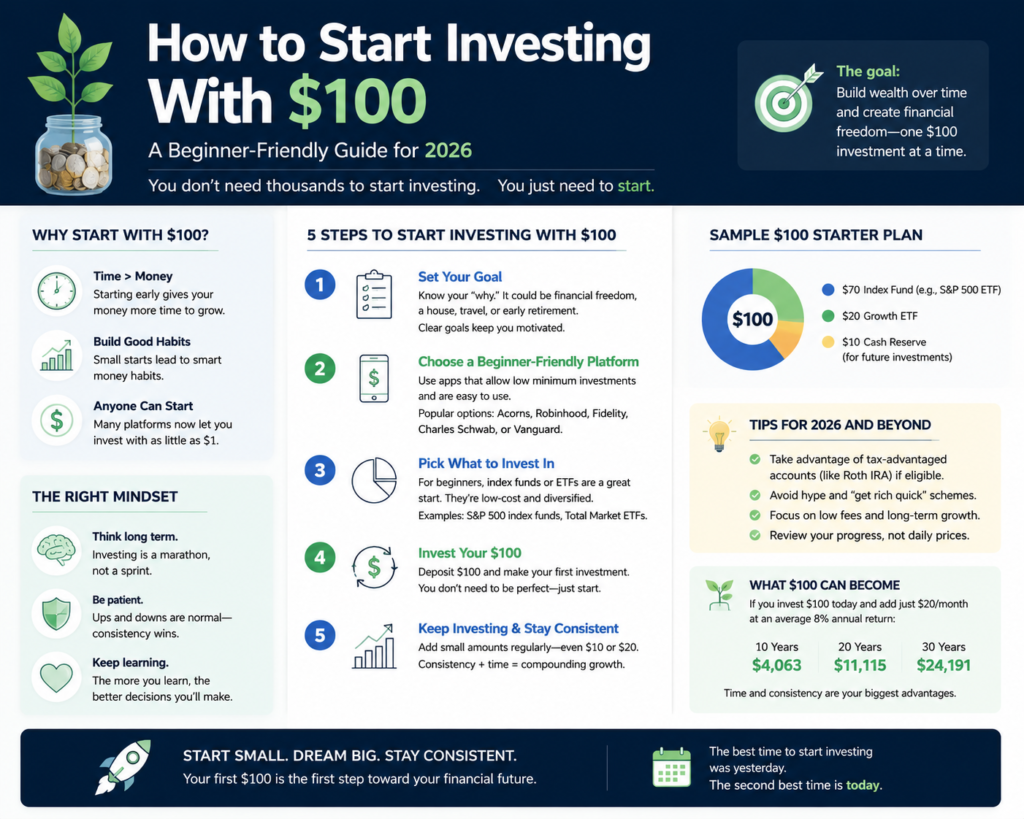
For many beginners in the USA, UK, and global markets, $100 may feel too small to matter. But investing is less about the first amount and more about building a repeatable system. Even a small starting amount can teach you how markets work, how fees affect returns, and how compounding grows money over time.
Disclaimer: This article is for educational purposes only. Income, results, and earnings may vary based on skills, effort, market demand, experience, and consistency. This is not financial advice.
Affiliate Disclosure: Some links mentioned in this article may be affiliate links. If you purchase through these links, the website may earn a small commission at no extra cost to you.
What Does It Mean to Start Investing With $100?
To start investing with $100 means using a small amount of money to buy assets that may grow in value over time. These assets can include stocks, exchange-traded funds, index funds, fractional shares, bonds, or other regulated investment products.
The goal is not to become rich overnight. The real goal is to:
- Learn how investing works
- Build discipline
- Understand risk and reward
- Start compounding early
- Create a long-term money habit
According to Investor.gov, compound interest means earning interest on both your original money and the interest it has already earned. For example, $100 earning 5% becomes $105 after one year, and then future growth builds on the larger amount.
That is why even a small investment can become meaningful when combined with time, consistency, and smart decision-making.
Can You Really Start Investing With Only $100?
Yes, you can start investing with $100. Many modern brokerage platforms allow beginners to buy fractional shares, ETFs, and low-cost funds with small amounts.
A few years ago, investing often required large minimum deposits. Today, many platforms have reduced barriers for beginners. This makes it easier for people in the USA, UK, and other countries to start with small amounts.
However, $100 should be treated as a learning foundation, not a shortcut to wealth.
What $100 Can Help You Do
| Purpose | How $100 Helps |
|---|---|
| Learn investing basics | You can understand how buying and holding assets works |
| Test a brokerage account | You can explore platform features with low risk |
| Buy fractional shares | You can invest in expensive companies with small money |
| Start ETF investing | You can access diversified funds |
| Build confidence | You can reduce fear by starting small |
| Practice consistency | You can add more money monthly |
The biggest benefit of starting with $100 is that it removes hesitation. Instead of waiting for the “perfect time,” you begin learning through action.
Why Starting Small Can Be a Smart Investing Strategy
Many beginners delay investing because they believe they need a large amount of money. This delay can be costly because time is one of the most powerful advantages in investing.
Starting small can help you:
- Learn without risking too much
- Avoid emotional decisions
- Build a monthly investing habit
- Understand market ups and downs
- Improve financial discipline
The UK Financial Conduct Authority explains that investing should generally be viewed with a long-term mindset, often at least five years, so investments have more opportunity to recover from short-term market movements.
This matters because beginners often panic when prices fall. Starting with $100 helps you experience volatility without putting your financial stability at serious risk.
Step 1: Build a Basic Financial Safety Check First
Before you invest your first $100, make sure your basic financial foundation is stable. Investing money you may need next week or next month can lead to stress and poor decisions.
Ask yourself:
- Do I have money for basic monthly expenses?
- Do I have high-interest debt?
- Do I have at least a small emergency fund?
- Can I leave this $100 invested for several years?
- Am I comfortable if the value drops temporarily?
The FCA suggests asking whether you are comfortable with the level of risk and whether you can afford to lose money before investing.
Simple Beginner Rule
If you may need the $100 for rent, food, bills, or emergency expenses, do not invest it yet. Keep it in savings.
Investing works best when you use money you can leave untouched for the long term.
Step 2: Understand the Difference Between Saving and Investing
Saving and investing are not the same.
Saving is usually for short-term needs. Investing is for long-term growth.
| Feature | Saving | Investing |
|---|---|---|
| Best for | Short-term goals | Long-term goals |
| Risk level | Usually low | Can be medium to high |
| Growth potential | Lower | Higher over time |
| Time frame | Days to 3 years | 5+ years |
| Example | Emergency fund | ETF, stocks, index funds |
If your goal is to buy something in the next few months, saving may be better. If your goal is long-term wealth building, investing may be suitable.
Step 3: Choose a Beginner-Friendly Investment Account
To start investing with $100, you need an investment account. The right account depends on your country.
For USA Beginners
Common options include:
- Taxable brokerage account
- Roth IRA
- Traditional IRA
- Employer-sponsored 401(k), if available
A taxable brokerage account is flexible, but retirement accounts may offer tax advantages. A Roth IRA can be useful for eligible beginners because qualified withdrawals in retirement may be tax-free.
For UK Beginners
Common options include:
- Stocks and Shares ISA
- General Investment Account
- Self-Invested Personal Pension, also called SIPP
A Stocks and Shares ISA is popular in the UK because investments can grow tax-efficiently within annual limits.
For Global Beginners
Depending on your country, you may have access to:
- Local brokerage accounts
- International investing platforms
- Mutual fund platforms
- Retirement investment accounts
- Regulated robo-advisors
Before opening any account, check:
- Regulation and licensing
- Fees
- Minimum deposit
- Available investments
- Tax rules
- Withdrawal rules
- Customer support
Step 4: Pick a Simple Investment Option
When you only have $100, simplicity matters. Beginners often make the mistake of buying random stocks, crypto, or trending assets without understanding risk.
A better approach is to focus on diversified, low-cost options.
Beginner-Friendly Investment Options
| Investment Option | Beginner Suitability | Risk Level | Why It May Help |
|---|---|---|---|
| Broad-market ETF | High | Medium | Offers diversification in one purchase |
| Index fund | High | Medium | Tracks a market index |
| Fractional shares | Medium | Medium to High | Lets you buy part of expensive stocks |
| Robo-advisor | High | Medium | Automates portfolio selection |
| Bonds or bond funds | Medium | Low to Medium | Can reduce volatility |
| Individual stocks | Low to Medium | High | Requires research and patience |
For most beginners, a broad-market ETF or index fund can be easier than choosing individual stocks.
Investor.gov explains diversification as spreading money among different investments so that if one loses money, others may help offset losses.
Step 5: Use Diversification Even With $100
Diversification is one of the most important investing principles. It means not putting all your money into one company, one sector, or one asset.
With only $100, you may think diversification is impossible. But ETFs and index funds make it possible.
For example, instead of buying one company’s stock, you could buy an ETF that holds hundreds of companies.
Example
If you invest $100 in one company:
- Your result depends heavily on that company
- Bad news can hurt your full investment
- Risk is concentrated
If you invest $100 in a diversified ETF:
- Your money is spread across many companies
- One company has less impact
- Risk is more balanced
FINRA explains that asset allocation, diversification, and rebalancing are important tools for managing investment risk.
Diversification does not remove risk completely, but it can help reduce the impact of one poor investment decision.
Step 6: Consider Dollar-Cost Averaging
Dollar-cost averaging means investing a fixed amount at regular intervals. For example, you could invest:
- $100 today
- Then $25 every week
- Or $50 every month
- Or $100 every month
FINRA explains that dollar-cost averaging involves investing equal portions at regular intervals regardless of market ups and downs.
This strategy can help beginners avoid the pressure of trying to guess the perfect time to invest.
Example Dollar-Cost Averaging Plan
| Month | Amount Invested | Action |
|---|---|---|
| Month 1 | $100 | Open account and buy first ETF |
| Month 2 | $25 | Add small contribution |
| Month 3 | $25 | Continue investing |
| Month 4 | $50 | Increase if budget allows |
| Month 5 | $50 | Stay consistent |
| Month 6 | $100 | Review and rebalance if needed |
Dollar-cost averaging does not guarantee profits. It simply creates a disciplined investing habit.
Step 7: Keep Fees Low
When investing only $100, fees matter a lot. A small fee can reduce your returns more than you realize.
For example:
| Fee Type | Why It Matters |
|---|---|
| Trading commission | Can reduce small investments quickly |
| Expense ratio | Annual cost of owning an ETF or fund |
| Account maintenance fee | Can eat into small balances |
| Withdrawal fee | Reduces flexibility |
| Currency conversion fee | Important for global investors |
If you invest $100 and pay a $5 fee, you immediately lose 5% of your investment. That is a big cost.
Look for:
- No-commission trading
- Low expense ratio ETFs
- No account maintenance fees
- Transparent pricing
- Regulated platforms
A low-cost approach is especially important for beginners.
Step 8: Avoid High-Risk Hype Investments
Many beginners are attracted to investments that promise fast returns. These may include meme stocks, unregulated crypto schemes, leveraged products, options trading, or social media “hot tips.”
These can be risky, especially for beginners.
Avoid investing based only on:
- TikTok or YouTube hype
- Telegram groups
- “Guaranteed profit” claims
- Fear of missing out
- Celebrity promotions
- Unknown apps
- Pressure to act quickly
The FCA warns that investors should be mindful of risk appetite, diversify investments, and only invest money they can afford to lose in high-risk products.
If an investment sounds too good to be true, it probably deserves extra caution.
Step 9: Create a Simple $100 Investing Plan
Here is a practical beginner plan for someone starting with $100.
Sample $100 Investing Plan
| Step | Action | Amount |
|---|---|---|
| 1 | Open a regulated brokerage account | $0 |
| 2 | Keep emergency money separate | $0 |
| 3 | Choose a low-cost diversified ETF | $80 |
| 4 | Keep cash for learning or future contribution | $20 |
| 5 | Set monthly auto-investing | $25–$100 |
| 6 | Review after 3–6 months | $0 |
This is only an example, not financial advice. Your personal plan should depend on your income, risk tolerance, goals, and country-specific tax rules.
Best Ways to Invest $100 as a Beginner
There are several ways to invest $100. The best option depends on your goal and comfort level.
1. Invest in a Broad-Market ETF
A broad-market ETF can give you exposure to many companies in one investment.
Examples of broad market exposure may include:
- U.S. total stock market ETFs
- S&P 500 ETFs
- Global stock market ETFs
- Developed market ETFs
This can be useful for beginners because you do not need to pick individual winners.
2. Use a Robo-Advisor
A robo-advisor asks about your goals and risk tolerance, then creates a portfolio for you.
This may be helpful if you want:
- Automated investing
- Portfolio rebalancing
- Beginner-friendly guidance
- Simple account setup
However, check fees before choosing a robo-advisor.
3. Buy Fractional Shares
Fractional shares allow you to buy part of a stock instead of a full share.
For example, if one share costs $500, you may still invest $10 or $25 in that company through fractional shares.
This is useful, but beginners should avoid putting the full $100 into one stock.
4. Start a Retirement Account
If you are in the USA, you may consider an IRA if eligible. If you are in the UK, you may consider an ISA or pension account depending on your goals.
Retirement accounts can offer tax advantages, but they may have rules and restrictions.
5. Invest in Yourself
Sometimes the best use of $100 is education.
You can invest in:
- Personal finance books
- Investing courses from credible sources
- Budgeting tools
- Skill-building resources
- Career development
If your income is low, increasing your earning power may produce better long-term results than investing $100 once.
Example: How $100 Can Grow Over Time
Investment growth depends on returns, fees, taxes, and market performance. There are no guarantees.
But here is a simple educational example.
| Starting Amount | Monthly Contribution | Hypothetical Annual Return | Time | Estimated Future Value |
|---|---|---|---|---|
| $100 | $25 | 6% | 10 years | About $4,100 |
| $100 | $50 | 6% | 10 years | About $8,000 |
| $100 | $100 | 6% | 10 years | About $15,900 |
| $100 | $100 | 6% | 20 years | About $46,500 |
These are only estimates. Real investment returns can be higher or lower. Markets can decline, and fees or taxes can reduce returns.
The lesson is simple: consistency matters more than the first $100.
Common Beginner Mistakes to Avoid
1. Waiting Too Long to Start
Many people wait until they have thousands of dollars. But starting small helps you learn earlier.
2. Investing Without an Emergency Fund
If you invest money you need for emergencies, you may be forced to sell during a market drop.
3. Chasing Hot Stocks
Buying a stock only because it is trending can be dangerous.
4. Ignoring Fees
Fees reduce returns. Beginners should understand trading fees, fund fees, and account fees.
5. Checking the Market Daily
Daily price movements can create stress and emotional decisions.
6. Selling Too Quickly
Investing is usually more effective when you think long term.
7. Copying Influencers Blindly
Online creators may not understand your financial situation. Always research before investing.
8. Putting Everything Into One Asset
Lack of diversification increases risk.
Pros and Cons of Starting Investing With $100
| Pros | Cons |
|---|---|
| Easy to start | Growth may feel slow at first |
| Low financial pressure | Fees can affect small balances |
| Helps build discipline | Limited diversification if choosing single stocks |
| Good learning experience | Requires patience |
| Can start compounding early | No guaranteed returns |
Starting with $100 is not about instant results. It is about building a foundation.
USA, UK, and Global Investing Considerations
USA Beginners
If you are in the USA, pay attention to:
- IRS tax rules
- Capital gains taxes
- Dividend taxes
- IRA eligibility
- Brokerage regulation
- SIPC protection limits
UK Beginners
If you are in the UK, consider:
- Stocks and Shares ISA rules
- Capital gains tax allowance
- Dividend allowance
- FCA-regulated platforms
- Currency conversion fees for U.S. stocks
Global Beginners
If you are outside the USA or UK, check:
- Local tax laws
- Platform regulation
- Currency exchange fees
- Access to U.S. or global ETFs
- Withdrawal rules
- Investor protection rules
Investment rules differ by country. Always check local regulations before investing.
How to Choose a Beginner Investing Platform
Before choosing a platform, compare these factors:
| Factor | What to Check |
|---|---|
| Regulation | Is the platform regulated in your country? |
| Fees | Are trading and account fees low? |
| Minimum deposit | Can you start with $100 or less? |
| Investment options | Does it offer ETFs, funds, or fractional shares? |
| Ease of use | Is the app beginner-friendly? |
| Education | Does it provide learning resources? |
| Security | Does it offer two-factor authentication? |
| Support | Can you contact customer service easily? |
Do not choose a platform only because it is popular. Choose one that fits your goals and risk level.
Practical Step-by-Step Checklist to Start Investing With $100
Here is a simple checklist you can follow.
Step 1: Set Your Goal
Decide why you are investing.
Examples:
- Retirement
- Long-term wealth
- Education
- Financial independence
- Learning investing basics
Step 2: Decide Your Time Frame
If your goal is less than 3 years away, investing may be too risky. If your goal is 5+ years away, investing may be more suitable.
Step 3: Choose an Account
Pick a regulated account based on your country.
Step 4: Choose a Simple Investment
For beginners, a diversified ETF or index fund may be easier than individual stocks.
Step 5: Invest Your First $100
Make your first investment only after understanding the risks.
Step 6: Automate Future Contributions
Even $25 per month can help build discipline.
Step 7: Review Every Few Months
Do not check daily. Review your plan every 3 to 6 months.
Step 8: Keep Learning
Read about diversification, taxes, risk, fees, and long-term investing.
Expert Tips for Beginners Starting With $100
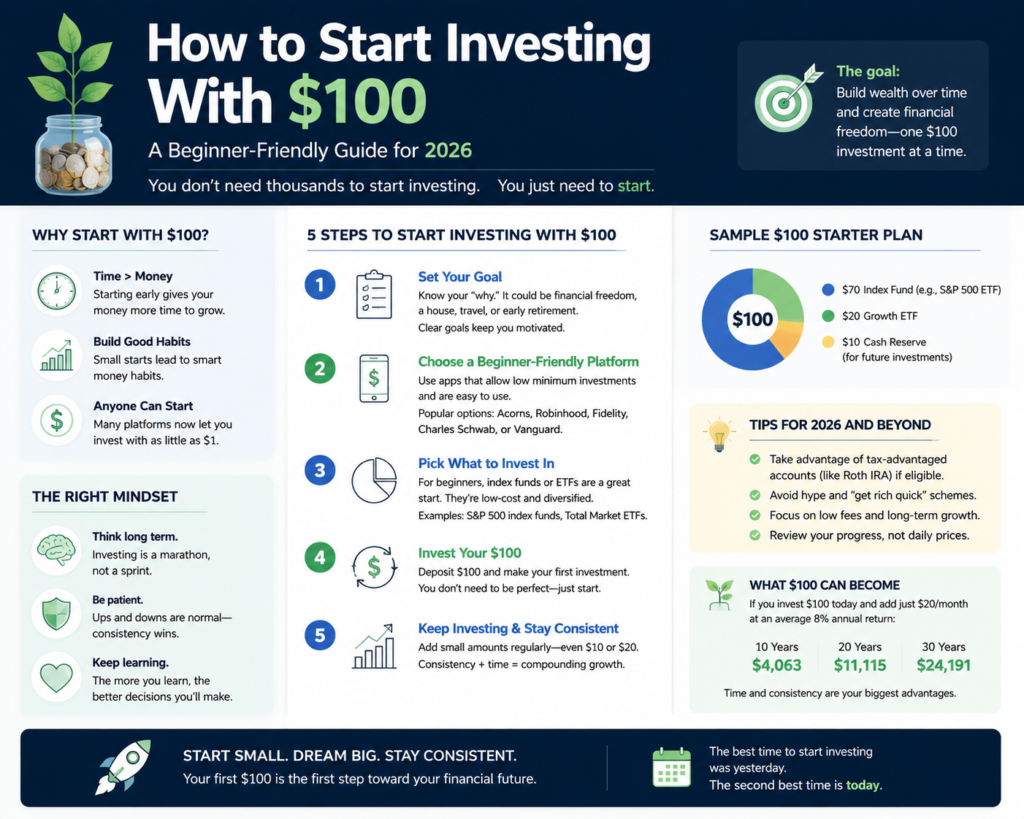
- Start with education before chasing returns.
- Avoid investments you cannot explain in simple words.
- Use diversification from day one.
- Keep fees low.
- Invest for years, not days.
- Do not panic during market drops.
- Increase contributions as your income grows.
- Avoid borrowing money to invest.
- Keep your emergency fund separate.
- Review your portfolio, but do not obsess over it.
Is $100 Enough to Build Wealth?
$100 alone is unlikely to build major wealth. But $100 can start the habit that builds wealth.
The real formula is:
Small start + consistent contributions + long time frame + diversified investing + low fees = stronger financial foundation
If you invest $100 once and never add more, growth may be limited. But if you invest $100 and continue adding money monthly, your long-term results may improve.
The most important part is consistency.
Conclusion: Start Small, Think Long Term
Learning how to start investing with $100 is one of the best first steps a beginner can take. You do not need to be rich to begin. You need a plan, patience, and a willingness to learn.
Start by checking your financial foundation. Then choose a regulated investment account, focus on diversified options, keep fees low, and avoid hype-driven decisions.
Your first $100 may not change your life immediately. But it can change your habits. And better habits can shape your financial future over time.
Investing is not about guaranteed income. It is about making informed decisions, managing risk, and giving your money time to grow.
FAQ: How to Start Investing With $100
1. Can I really start investing with $100?
Yes, many platforms allow beginners to start investing with $100 or less. You can consider ETFs, fractional shares, robo-advisors, or index funds depending on your country and goals.
2. What is the best way to invest $100 as a beginner?
A diversified, low-cost ETF or index fund is often beginner-friendly because it spreads your money across many companies. However, the best choice depends on your risk tolerance and financial goals.
3. Is it better to save or invest $100?
If you need the money soon, saving is usually better. If you can leave the money invested for several years and accept risk, investing may be suitable.
4. Can I lose money investing $100?
Yes. All investments carry risk. Your $100 can go down in value, especially in the short term. That is why diversification and long-term thinking are important.
5. Should I invest $100 in one stock?
Beginners should be careful about putting all their money into one stock. A diversified ETF or fund may reduce the risk of depending on one company.
6. How often should I invest after my first $100?
You can invest monthly, weekly, or whenever your budget allows. Many beginners use dollar-cost averaging by investing a fixed amount regularly.
7. Is crypto a good place to invest my first $100?
Crypto can be highly volatile and risky. Beginners should understand the risks carefully before investing. It may not be suitable as a first investment for everyone.
8. How long should I keep my $100 invested?
Investing usually works best with a long-term time frame, often 5 years or more. Short-term investing can be risky because markets can move sharply up or down.
Leave a Reply